
To a Big 4 Partner, Everything Is Amazing
Field notes on the last adjective left in professional services.

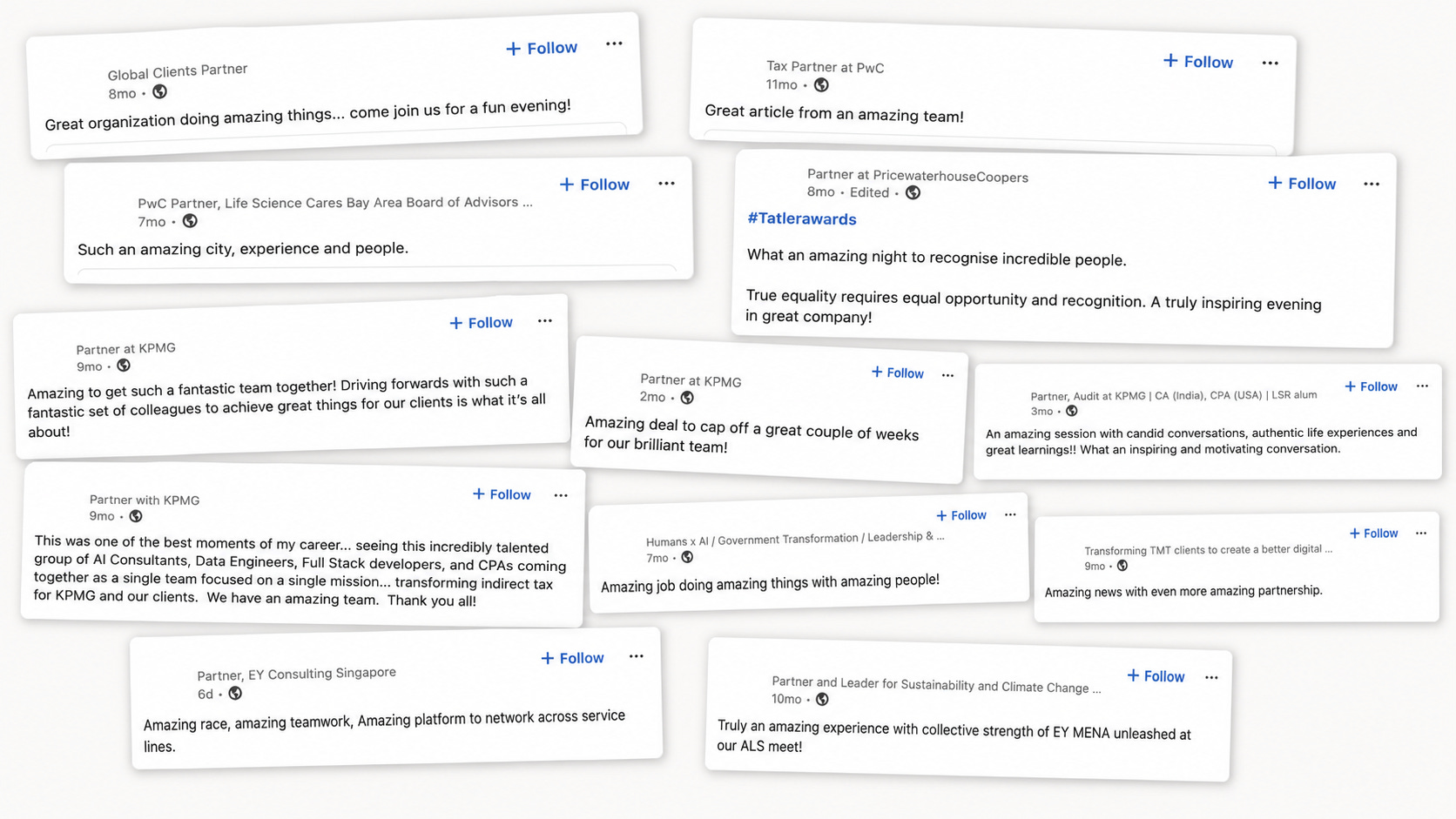
“Amazing race, amazing teamwork, Amazing platform to network across service lines.”
“Amazing job doing amazing things with amazing people!”
“Amazing news with even more amazing partnership.”
Every one of these was posted within the last twelve months by a serving partner at a Big 4 firm. (The capital A in the middle of the first one is original. We checked.) Nobody had to hunt for them, either. Ten minutes of scrolling partner LinkedIn and the feed delivers them to you, the way the ocean delivers plastic.
Stay a little longer and you get the full range of the genre. The team is amazing. The client is amazing. The deal is amazing. The offsite is amazing, as is the city hosting it, the lounge at its airport and, in one documented case, the air. The panel was amazing (the poster was on it). The insights were amazing (the poster delivered them). When “amazing” needs a rest, “brilliant” and “fabulous” come off the bench, and an “incredible journey” is always warming up. One post in our collection reports “collective strength of EY MENA unleashed” at an internal leadership summit, which sounds less like professional services than the third act of a superhero film. A partner elsewhere in the folder came away from a session with “great learnings!!”, two exclamation marks, presumably because one could not have carried all that learning alone.
One of us keeps a running file of these. (It is not a small file.) The current record is a thirty-word post that uses “amazing” six times, which works out to one every five words, a cadence otherwise achieved only by toddlers at aquariums. We are aware of how petty it is to count. We counted anyway, because the number is the observation: the most senior people in the world’s most expensive advisory firms have converged, in public, on a single adjective, and the adjective is the one that says the least.
Same partner, different room
The generous reading is that the enthusiasm is sincere, and we would extend it if we had not spent thirty years in the rooms where the same partners discuss the same teams and clients with the door shut. The private register exists. It is fluent and specific, and it does not contain the word amazing.
Take a composite week, one all of us have lived through more often than we would like to admit. Monday, the partner posts about the amazing team and the amazing energy at the client workshop. Tuesday is talent calibration, where two members of that team are described as underperforming the grade and a third as a flight risk who should be encouraged toward the exit before promotion season complicates the math. Wednesday is the account review, where the amazing client has not paid the last two invoices, cannot make a decision without four pre-meetings, and has pushed the scope to a place where somebody finally says write-off. Thursday the partner spends forty minutes on the phone trying to move the team’s weakest senior onto someone else’s engagement, praising them in terms Monday’s post would recognize. Friday, another post: amazing week, amazing people, grateful.
None of the private talk is scandalous. It is the ordinary candor of people paid to assess things, and it proves the diagnostic muscle still works fine. What the communications machinery actually controls is location. Enthusiasm got licensed for outdoor use; candor moved indoors, like smoking.
And the audience knows. The team praised in Monday’s post was the subject of Tuesday’s calibration and heard about it within the week, because juniors always hear. The client has read enough posts about other amazing clients to decode the ones about themselves. The performance continues anyway, which tells you the applause it seeks is not theirs.
Partners used to sound like owners
For most of the profession’s history, partners made almost no public sound at all. Client rooms, yes; the record, rarely. When the partner voice did appear in public, it showed up in technical journals, in comment letters informing the standard-setters that they were wrong, in conference speeches that contained actual positions. That writing was dry, precise, sometimes combative, and it had the one credential the current feed cannot counterfeit: the confidence of a professional who answered to clients and to the partnership and to nobody else. Some of us wrote those pieces. We fought over single sentences for days, because the sentences were ours and the name underneath them meant something. Nobody ever asked us to be amazing.
The shift to the current register happened inside fifteen years, which is fast for a profession that took the better part of a century to agree on how to depreciate a building. Four things drove it, and they compound.
Four things changed
First, the title kept its name and lost its meaning. A partner in 1995 was an owner: capital genuinely at risk, a vote that counted, a personal franchise, and unlimited liability to concentrate the mind. The past two decades added salaried partners, income partners, directors doing partner work without the equity, and, above the whole pyramid, a global executive layer that behaves like the management of any multinational, because that is what it is. A present-day partner has a capital account and a boss. People with bosses communicate like people with bosses. Middle managers do not publish opinions; they publish enthusiasm, aimed upward. We watched colleagues make that adjustment in real time. The quickest studies did best.
Second, the scandals taught management which control is cheapest. Improving audit quality costs money, takes years, and shows up in nobody’s quarter. Controlling what partners say about it costs a policy memo. So after every failure of the past twenty years, the reliable institutional output was a communications upgrade: the social media guideline that grew from one page into a manual, the media training that teaches everyone to bridge to the positive, the review chain that added legal, then brand, then risk. After #MeToo the ratchet turned again, and the list of things a partner must never touch in public reached its current form. No clients (confidentiality). No competitors (defamation). No regulators (relationship). No politics (policy). No commentary on the firm’s own troubles (career). Take all of that out of a working professional’s life and ask what remains to post about. Adjectives.
Third, marketing discovered the distribution channel. Somewhere in the mid-2010s, a firm with three thousand partners noticed it was sitting on three thousand broadcast towers, and the machinery followed: social selling programs, employee advocacy platforms, the Tuesday email from brand containing pre-drafted posts and a cheerful invitation to personalize before sharing. Several firms track the output on internal dashboards, and visibility has become a line in year-end conversations. The posts are also recruiting collateral, since a 24-year-old choosing between offers reads the feed, and the feed must therefore show grinning teams at offsites rather than anyone at a desk at 1 a.m. A meaningful share of what appears under a partner’s name was drafted two floors away from the partner. We have seen the content calendars.
Fourth, the internal tournament moved onto the feed. Partners once differentiated on a client book or a technical reputation, and that competition happened in rooms. As the firms institutionalized their big relationships — global accounts, rotating lead partners, succession by committee — the personal rolodex depreciated, and visible devotion appreciated in its place. A compensation committee cannot easily measure judgment. It can count posts. Tagging the regional managing partner in a tribute to an amazing leadership summit is a compensation argument, made in public, with timestamps. And the likes travel the direction everything travels in a partnership: upward. The team likes the partner’s post inside an hour, the partner likes the practice leader’s, the practice leader likes the CEO’s. Forty reactions, thirty-eight of them from people whose year-end ratings the poster controls, and every participant knows it and none of them says it.
The null post
Combine the four and only one register remains available. A population of formerly independent professionals, employees now in everything but tax treatment, barred from specifics, supplied with pre-drafted enthusiasm, and rewarded for public displays of loyalty, will converge on the word that commits to nothing. No claim, no number, no comparison, no opinion for a general counsel to flag. “Amazing” is the null post: maximum visibility, zero risk. The LinkedIn edition of the eighty-slide deck with no recommendation in it.
The vocabulary is a symptom. The old dry voice, whatever its charms, was evidence of the product clients believed they were buying: a senior professional with the standing to say an unwelcome thing. A partner who cannot risk a public opinion on the industry, the standard, or the weather is telling you, well in advance, how the contested judgment call with your CFO will go in the fourth quarter. Clients read the feed, whether or not they think of it as reading. So does the senior talent the firms keep wondering how they lost; a 32-year-old with options looks at what a partner is now permitted to sound like and prices the title accordingly.
None of which makes the people in our folder fools. Posting this way is the rational move inside the current incentive set, most partners privately read their own output exactly the way you do, and the eye-rolling in the partner lounge is close to universal. The interesting question is who built the incentive set, and the pattern is the clue: adjective density tracks corporatization. Big Law developed the same condition on roughly the same schedule, as its partnerships centralized. The founders of ten-person boutiques, meanwhile, still post opinions with verbs in them, because they still own what they built and nobody reviews their drafts.
So, a challenge for this comment section, offered as a genuine research question and only partly as a trap: can you find one public statement from the past twelve months, by a serving Big 4 or MBB partner, that a client, a regulator, or the firm’s own brand team could plausibly object to? An article, a post, a conference remark, anything on the record. Post the link. We went looking ourselves and came back with a folder full of amazing.
Love this account, makes me almost wistful…