
A Complete Inventory of Our Hypocrisy
A transparent accounting of every way we still benefit from the system we spent last week criticising

It took five days.
We published our first post on a Sunday. By Friday morning, someone had filed the charge sheet: retired partners criticising the industry while still collecting retirement from the firms they left. Still holding equity. Still using the old titles to win advisory work. Still dining out on the brand they claim is broken.
The accusation stung. We gathered on a conference call and sat in uncomfortable silence, confronting the contradictions of our position. Then someone said “maybe we should shut it down,” and the rest of us nodded slowly, chastened by the weight of our own complicity. Mike started sobbing uncontrollably. Bob put on his sunglasses, inside, like a man in a witness-protection programme who has already been identified. Anna started mumbling something about having to change her will and leaving everything to a charity. Gerald, who had not spoken in eleven minutes, whispered “I’ll tell my wife,” and no one asked what he meant.
We got caught, and the burden was just too much.
Nah. Just pulling your leg.
Mike forwarded the email to the group chat and someone replied , “Only five days? I had three in the pool.” Bob then sent a photograph of his quarterly retirement statement with a red circle around the direct-deposit line and the caption “blood money.” Anna, a former senior partner at a firm we have already been rude about, responded with: “lol.” Gerald sent a thumbs-up emoji, which, from a man who once billed a client for “stakeholder alignment,” felt about right.
We owe the accusation a serious answer, and we intend to give one. But first, in the spirit of the transparency we keep demanding from the firms, a full and voluntary disclosure of the conflicts of interest. Think of it as a prospectus, except the risk factors are all true and none of them are in eight-point font.
The inventory
Between us, the contributors to this publication currently receive retirement payments, deferred compensation, or both from our former firms. The quarterly statements arrive on schedule. We have not, to date, returned any of them. We have not considered returning any of them. John reports that he considered donating his to charity for about forty-five seconds before remembering he still has a mortgage on his fourth chalet. He wishes us to note that it is a “modest” chalet. It has only one wine cellar.
Several of us still hold equity or equity-equivalent interests in the firms we left. The value of that equity is directly tied to the profitability of the firms we are now publicly arguing have a broken business model. If we are right, we are making ourselves poorer. We have decided to accept that trade-off with a courage born of the knowledge that our firms would first financially hurt all the worker bees, then the junior partners, before they would consider impacting the compensation of senior partners still influential in their respective industries. In other words, we are brave in the specific and limited sense that the bill will land on someone else’s desk before it reaches ours.
Our LinkedIn profiles still say “Former Partner at [Firm].” We have left them that way because removing the line would cut inbound advisory inquiries roughly in half. When a prospective client calls and says “I see you were a partner at [Firm],” we do not reply “yes, but I now believe the firm’s operating model is structurally flawed and its quality has been declining for a decade.” We say “yes,” pause for the appropriate beat of gravitas, and quote our day rate. We have, on occasion, quoted it in the same breath. Efficiency is a value we still respect.
Bob advised a client last month on whether to hire the firm in question for a transformation engagement. He reviewed the proposal, identified the usual problems (too many juniors, vague milestones, a “proprietary framework” that was a 2×2 matrix with new labels and a gradient fill), and recommended the client negotiate a 30% fee reduction and demand named senior resources. The client followed the advice. Bob billed twelve hours for it. The invoice has been paid. Bob does not feel conflicted about this, though he concedes he probably should. He has conceded this every quarter for six years. The concession has not yet affected his billing rate.
Several of us sit on advisory boards or hold board seats that we obtained partly because of where we used to work. Jack is on the advisory board of a company that is currently a significant client of a firm we published a case study about last week. That case study was not complimentary. The next advisory board meeting is in September. We anticipate polite but pointed questions over the pastries. Jack has already rehearsed an answer. It involves the phrase “I’m sure it’s more nuanced than that” and a strategic reach for a croissant.
We attend industry conferences where our name badges still carry the old firm logos, because the conference organisers know which logos sell tickets. We give guest lectures at business schools where we open with “when I was at [Firm]” because that is the sentence that makes the room pay attention. We attend dinners where half the table currently works at firms we spent Tuesday criticising, and we enjoy the wine and the conversation, and nobody mentions the Substack, and we do not bring it up either. The wine, for the record, is always very good. This is, we suspect, not a coincidence. The firms have always understood that a well-chosen Barolo is cheaper than a well-chosen argument.
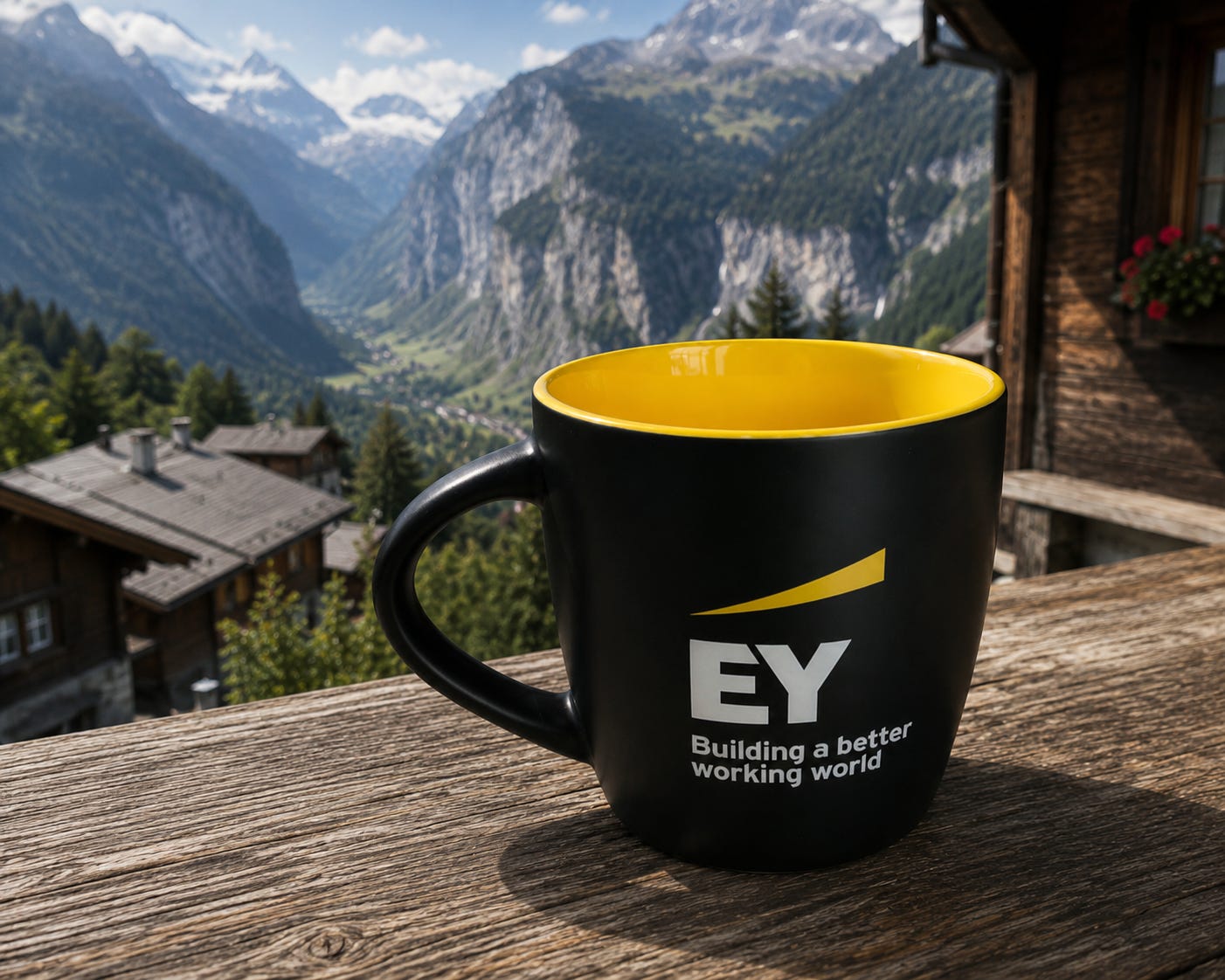
The branded merchandise deserves its own paragraph, though not a long one. Several of us still own firm-logo golf shirts. John uses an EY coffee mug every morning. It has a chip on the rim. He has had it for fourteen years. When asked why he does not replace it, he said the firm gave him the mug in lieu of a meaningful retention conversation in 2012, and he intends to get his money’s worth. He was then asked whether drinking from a branded mug while writing a publication critical of the brand constituted some form of conflict of interest. He said the coffee tastes the same regardless of what is printed on the outside, and that this was, if anything, a metaphor for the firm’s consulting output. He then drank from it, at length, while maintaining eye contact with the person who had asked the question. He is, even in retirement, very good at billable silence.
For the record, we tried to put a picture of the mug at the top of this post. We ran it through an AI image tool to beautify it and de-identify the chip and the location. We suppose this now qualifies us as AI consultants. We considered using a stock photo of a gavel, or a suited figure staring pensively out of a window, or a handshake over a mahogany table—the visual vocabulary of every thought-leadership PDF since 2009. The AI-updated mug won because it cost nothing extra, which is consistent with our general approach to expenditure and, coincidentally, with the approach our former firms take to junior staffing.
The admission
There it is. That is the list, or at least the portion we can disclose without our lawyers sending emails. The lawyers, incidentally, also used to work at the firms. The conflicts nest. It is very efficient. Every item is true. None of it is a secret. Some of it is genuinely funny, if you have spent enough years inside the system to recognise the absurdity of a man drinking from a chipped corporate mug while writing about the corporation’s decline.
And we are going to keep writing anyway.
The accusation rests on a premise that sounds intuitive but is wrong: that personal benefit and honest criticism cancel each other out. They do not. A doctor who smokes can still read a chest X-ray. A retired general collecting a military pension can still identify a flawed battle plan. A former partner receiving deferred compensation can still count the number of times PCAOB deficiency rates doubled in three years. (It was once. From 12% to 26%. The deferred compensation did not obscure the arithmetic. Neither, we note, did the complimentary espresso in the partner lounge.)
If the billing economics we described in The Leverage Trap are wrong, show us the numbers. If the scandal timeline contains errors, name them and we will publish a correction the same day. If our assessment of AI readiness in $10 Billion in AI Investment overstates the problem, produce the evidence. These are standing offers. We mean them. We even mean them on the days the retirement deposit clears.
But “you still get retirement payments” is not a rebuttal to any of that. It is a change of subject. We recognise the move because we perfected it. We have a plaque. It is in a drawer. We do not display it, but we do not throw it away either. See: mug.
We know this move
Twenty-plus years inside these firms taught us one reliable pattern: when someone raises an uncomfortable question about the work, the first instinct is never to address the work. The first instinct is to question the person. “They don’t really understand the methodology.” “The client isn’t technical enough to evaluate this.” “She has her own agenda.” Redirect attention from the substance to the source, and the substance never has to be defended. It is the oldest trick in the deck, and the deck is branded, and the deck was billed at £4,200 a day.
The hypocrisy accusation is that play, run from the other side of the table. Do not engage with the utilisation maths. Do not argue the conflict-of-interest analysis. Do not explain why four consecutive years of admitted audit failure at a single client produced a fine that rounds to zero against firm revenue. Just point out that the people asking the questions used to benefit from the system, and declare the questions invalid. Applaud the redirect. Order another round. The pastries are very good at these meetings. They are always very good.
We deployed that move in client meetings, partner retreats, and press briefings for two decades. We know exactly how effective it is: very, right up until someone decides to ignore it and ask the question again.
So: we are hypocrites. Stipulated. Entered into the record. Noted with the same forensic enthusiasm we usually reserve for audit deficiency rates. We have initialled every page. We have added a cover sheet. The cover sheet has a disclaimer.
The maths, however, do not care who presents them. And the maths are correct.
If you disagree with the analysis, we would genuinely enjoy hearing why. We have a comment section. We have an email address. We have a standing offer to publish corrections, and we have enough professional pride to take a well-argued rebuttal seriously.
If, on the other hand, your strongest objection is that we still drink from the mugs, we would respectfully suggest that the argument deserves a better opponent. And possibly a better mug. Ours is chipped. Yours, we suspect, is branded.
We will be here. Writing, collecting retirement, and drinking coffee from a chipped mug we got for free in 2012. Some habits, like some business models, outlast the logic that created them. The difference is that the mug still works.
This is a genuine invitation. If you think the hypocrisy disqualifies the analysis, pick any post we have published, identify the specific claim you believe is wrong, and make your case. We will engage with it publicly and we will do so without charging our day rate.